Avoidable Claim Touches

Eliminate the noise & optimize labor capacity in the revenue cycle

The benchmark that separates efficient teams from busywork factories

Avoidable touches are unnecessary follow-ups or interactions with insurance claims that do not move the claim closer to resolution. These include checking on claims that are still processing, following up too soon, or working claims already paid but not yet posted. Avoidable touches waste staff time, increase labor costs, and reduce overall efficiency in the revenue cycle.

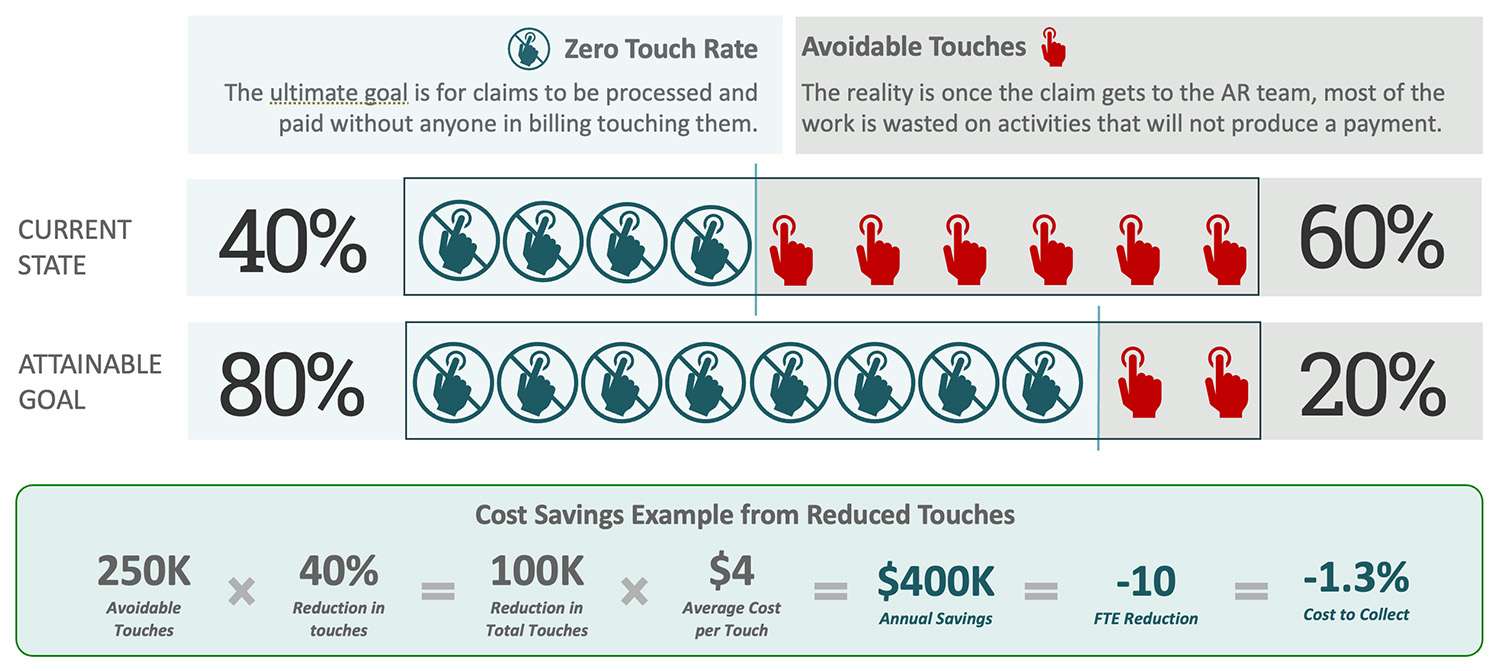
In the first month of go-live with a client, we typically see anywhere from 60% to 80% of touches being avoidable. I’ve even seen cases as high as 90%. What does that mean in real terms? Let’s say you have 10 representatives. In this example, the organization had 60% of their touches classified as avoidable—and that’s actually on the low end. Most baselines we see are between 70% and 80%. The benchmark we aim for with clients is 20% or less.

The real ROI of reducing excessive touches

When you start reducing excessive touches, you free up labor capacity. That means fewer people are needed to handle the same amount of work. For instance, if an organization has 250,000 avoidable touches per year and you reduce just 40% of them, at an average cost per touch of $4 (ranging from $3.50 to $6 depending on whether labor is domestic or offshore), you save about $400,000 annually in FTE costs—or the equivalent of 10 full-time employees.

So ask yourself: what could you do if you had 10 fewer people needed and improved your cost to collect by 1.3%—simply by reducing wasted touches? How do you identify those wasted touches? By tracking status codes with our Effective Intelligence® workflow automation solution. We associate each status with either a wasted or a non-wasted touch.

Work queue traps: how bad setup creates fake work

Examples of wasted touches include:

  • Claims already paid but not posted.

  • Claims still in process with the payer.

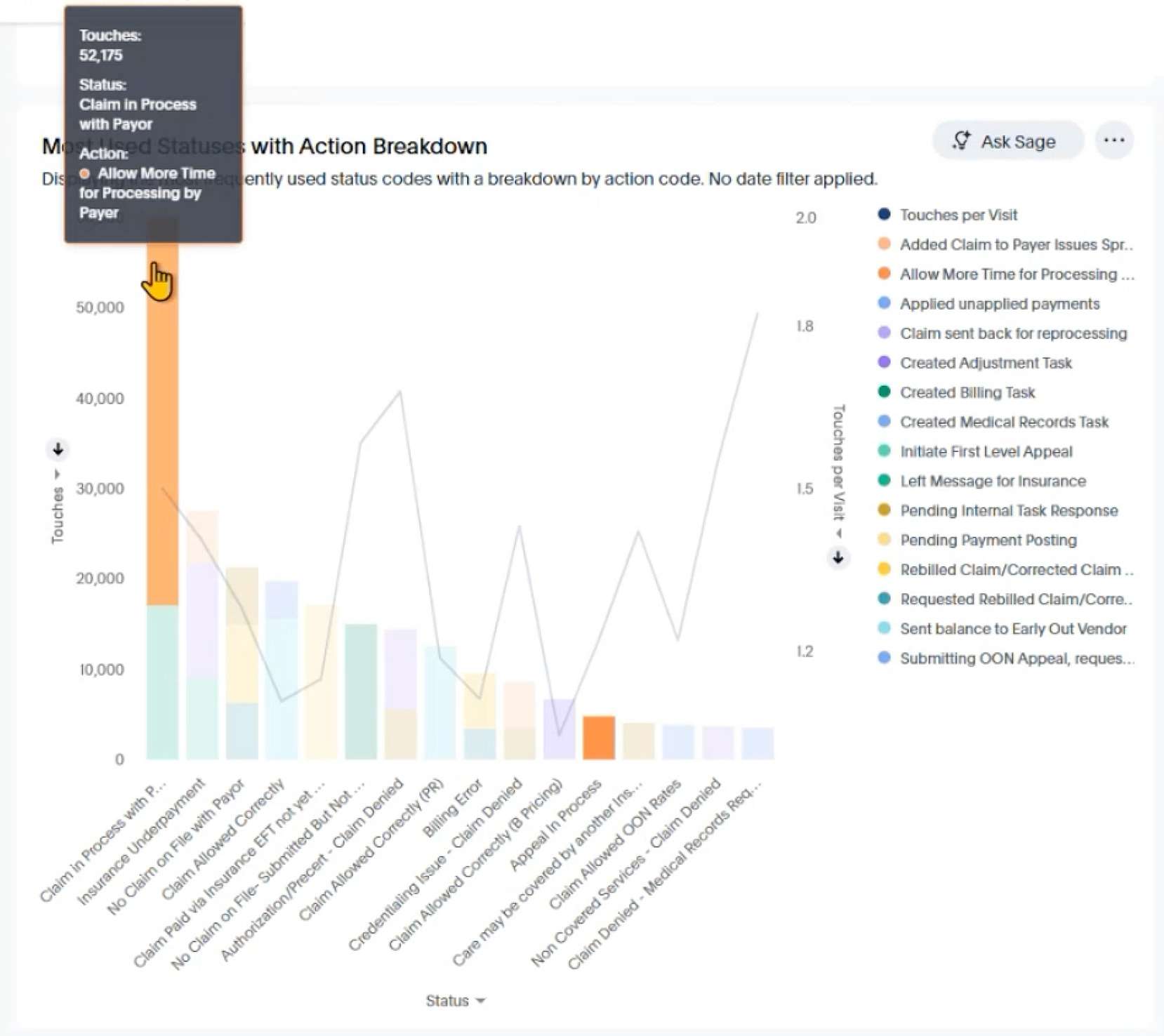
In one organization, over 50,000 touches in a given period were simply claims still in process—not denied, not paid, just pending. That’s one of the top categories we see, along with claims paid but not yet posted.

So why does this happen? Often it’s because work queues are set up poorly. For example, if a queue shows “non-denied” claims at day 21, but Blue Cross typically pays at day 31, you’re following up too soon. Set that queue to 32 days instead in our Effective Intelligence® insurance A/R module settings.

Another common inefficiency: staff insisting they need to check on claims every seven days. But do they really? No. In our system, you can configure action codes with minimum and maximum follow-up dates. If someone selects an action, I won’t allow them to push it out just seven days—I might enforce a minimum of 30 or 45 days instead.

The payoff? Turning insight into efficiency and margin gains

With our system, clients can see unpaid claim statuses in much more detail—and, just as importantly, the actions being taken. This helps organizations truly understand the work effort tied to adjudication. For example, take the “claim in process with payer” status in the example above. Many of these claims just require more time for processing. Yet the average touches per visit in that category is 1.5. That means half of those claims were touched again unnecessarily, which doubles the labor and eats into profit margin. That’s when clients begin to see the real value: understanding and reducing wasted touches to improve efficiency, reduce cost, and protect margins.

About Matt Seefeld

Matt Seefeld, Chief Executive Officer at MedEvolve, brings over 24 years of management consulting experience in the healthcare industry. He has extensive expertise in the assessment, design and implementation of process improvement programs and technology development across the entire revenue cycle. Matt began his career with Stockamp & Associates, Inc. and worked for both PricewaterhouseCoopers LLP and Deloitte Consulting LLP in their healthcare and life sciences practice lines. In 2007, he developed a business intelligence solution and founded Interpoint Partners, LLC, where he served as Chairman and Chief Executive Officer. In 2011, he sold his business to Streamline Health Solutions where he then served as Chief Strategist of Revenue Cycle followed by Senior Vice President of Solutions Strategy until 2014. Matt ran global sales for NantHealth and provided consulting services for healthcare technology and service businesses nationwide, prior to joining MedEvolve full-time.


Read more articles from Matt >>

Effective Intelligence: Our comprehensive RCM automation solution

Effective Intelligence combines Patient Financial Clearance Automation, Medical Billing Workflow Automation, and Real-Time RCM Analytics in a cloud-based platform designed to integration with your current EMR/PM technology to measure the effectiveness of your RCM staff.

Review and assess your practice’s financial status in 5 min or less and know exact where you are losing money and why. Measure the work effort of every revenue cycle employee, incentivize and retain your top performers, and help employees that need improvement.

You can prevent most common denials, rejections and write-offs during the scheduling and pre-registration process in advance of the appointment. Configure checkpoints and use central task management to quickly clear patients and keep your front office staffing needs at a minimum.

As team members log in to the web-based application and record each “touch” of a claim,  outcome, and next task, key data points are recorded like who completed the task and when, outcome, task notes, internal / external messages sent, collection success and other data points that feed into our real-time analytics.

Reduce RCM labor dependence with financial clearance, insurance A/R, & patient A/R automation modules with real-time analytics.

Increase productivity and simplify front & back office processes while keeping your staff focused with our flagship PM system.

Recent Posts